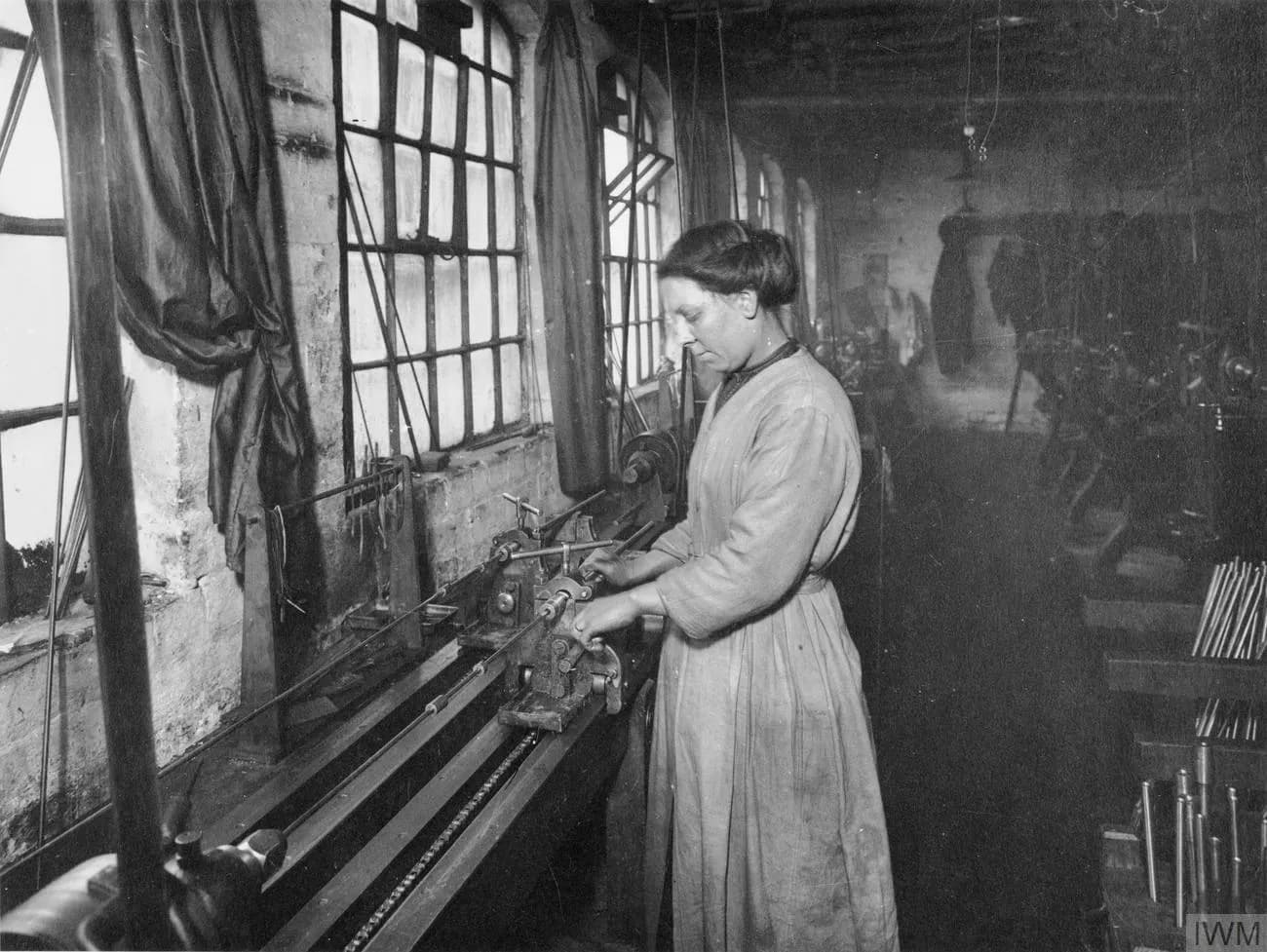
For 172 years, the marshy island at Enfield Lock was the beating heart of British military manufacturing. From muzzle-loading muskets to the rifles that armed soldiers through two world wars, the Royal Small Arms Factory (RSAF) shaped the nation's military history before transforming into one of North London's most distinctive residential communities.
Origins on the Lea
The factory was established in 1816 on a site bordered by the River Lea and the Lee Navigation, though land acquisition had begun as early as 1812. Its creation followed dissatisfaction with the poor quality and high cost of British weapons used during the Napoleonic Wars. The government sought to centralise and modernise small arms production, moving operations from a short-lived royal manufactory in Lewisham to this Enfield location.
Engineer John Rennie the Elder advised on the site's development, recommending a navigable leat to facilitate transport. Captain John By drew up plans for three mills, though the ambitious scheme was scaled back. George Lovell, appointed as the factory's first superintendent, proved instrumental in establishing its reputation for precision engineering. The barrel branch transferred from Lewisham in 1816; lock and finishing operations followed by 1818.
The Lee–Enfield: A Weapon for the Ages
The factory's greatest legacy is the Lee–Enfield rifle, first designed in 1895. This bolt-action rifle would remain standard British Army issue through both world wars and beyond, serving in more than 30 conflicts worldwide. Over 17 million Lee–Enfield rifles were manufactured in total.
The rifle's distinctive feature was its rapid-fire capability. A trained soldier could fire 20 to 30 aimed shots per minute; in 1914, Sergeant Instructor Snoxall set a world record by placing 38 rounds into a 12-inch target at 300 yards in one minute. German forces in the First World War reportedly believed they faced machine guns when encountering skilled British riflemen capable of this "mad minute."
The Enfield factory alone produced 626,330 Short Magazine Lee–Enfield rifles in 1918, contributing to a wartime output of over two million SMLE rifles. To meet demand, two additional Royal Ordnance Factories were established at Fazakerley and Maltby.
Innovation and Industrial Scale
The RSAF pioneered American-style mass production in Britain. Following the Crimean War (1853–1856), a machine shop built in 1856 adopted production-line techniques with standardised, interchangeable parts. The factory's Pattern Room held a master set of every weapon manufactured there, a collection now housed at the Royal Armouries Museum in Leeds.
The facility produced an extraordinary range of weaponry beyond the Lee–Enfield: the Snider–Enfield and Martini–Henry rifles of the Victorian era; the Bren light machine gun from 1935; the Sten submachine gun during the Second World War; and eventually the SA80 assault rifle from 1987.
A Community Forged in Steel
The factory created more than weapons; it built a community. Government Row, a terrace of cottages constructed between two watercourses, housed workers and their families. The settlement had its own school, church, police station, and fire brigade.
Public houses served the workforce: the Royal Small Arms Tavern (later The Rifles), the Greyhound, the Ordnance Arms, and the Plough, the latter two still operating today. During the First World War, the government granted 24-hour drinking licences to four local pubs, with the condition that no "treating" occurred, as the factory had no canteen.
By 1856, the workforce had reached 1,000; by 1887, it employed 2,400 people. The community that grew around the factory developed a distinct working-class identity that persisted across generations.
Closure and Transformation
The RSAF was privatised in 1984, becoming part of Royal Ordnance Plc and later British Aerospace. Closure was announced in August 1987; the site shut in 1988, with machinery auctioned off that November.
British Aerospace formed a joint venture with Trafalgar House to redevelop the site. Fairview Homes acquired it in 1996 and constructed Enfield Island Village between 1997 and 2003 on the 100-acre brownfield site. The development includes housing ranging from one-bedroom flats to five-bedroom houses, with 25 per cent designated as social housing.
The original Machine Shop frontage, a Grade II listed building, was retained and restored at a cost of £4 million between 1998 and 2001. The RSA Island Centre opened in October 2001, housing the RSAF Interpretation Centre, which preserves the factory's industrial heritage. The centre holds the John Thwaites birdcage clock from 1783 and "Albert," a bell cast at Woolwich Arsenal in 1857.
Local Legacy Today
The RSAF Interpretation Centre opens by appointment and during London Open House Weekend each September. The RSA Trust continues collecting oral histories from former employees, creating an archive of personal stories that complement the official record.
The site sits within Lee Valley Park and the Enfield Lock Conservation Area. The London Outer Orbital Path (London LOOP) Section 18 passes through, as do National Cycle Route 1 and EuroVelo 2 along the River Lee towpath. The former police station, water tower, and other historic buildings remain as part of the development, surrounded by flood defences on this former flood plain.
From producing rifles that armed British soldiers across two centuries to providing homes for modern Enfield families, the island at Enfield Lock has undergone a remarkable transformation. The Royal Small Arms Factory's contribution to British military history endures in museum collections and the continued service of Lee–Enfield rifles in some Commonwealth nations, even as its former grounds have found new purpose as a residential community.