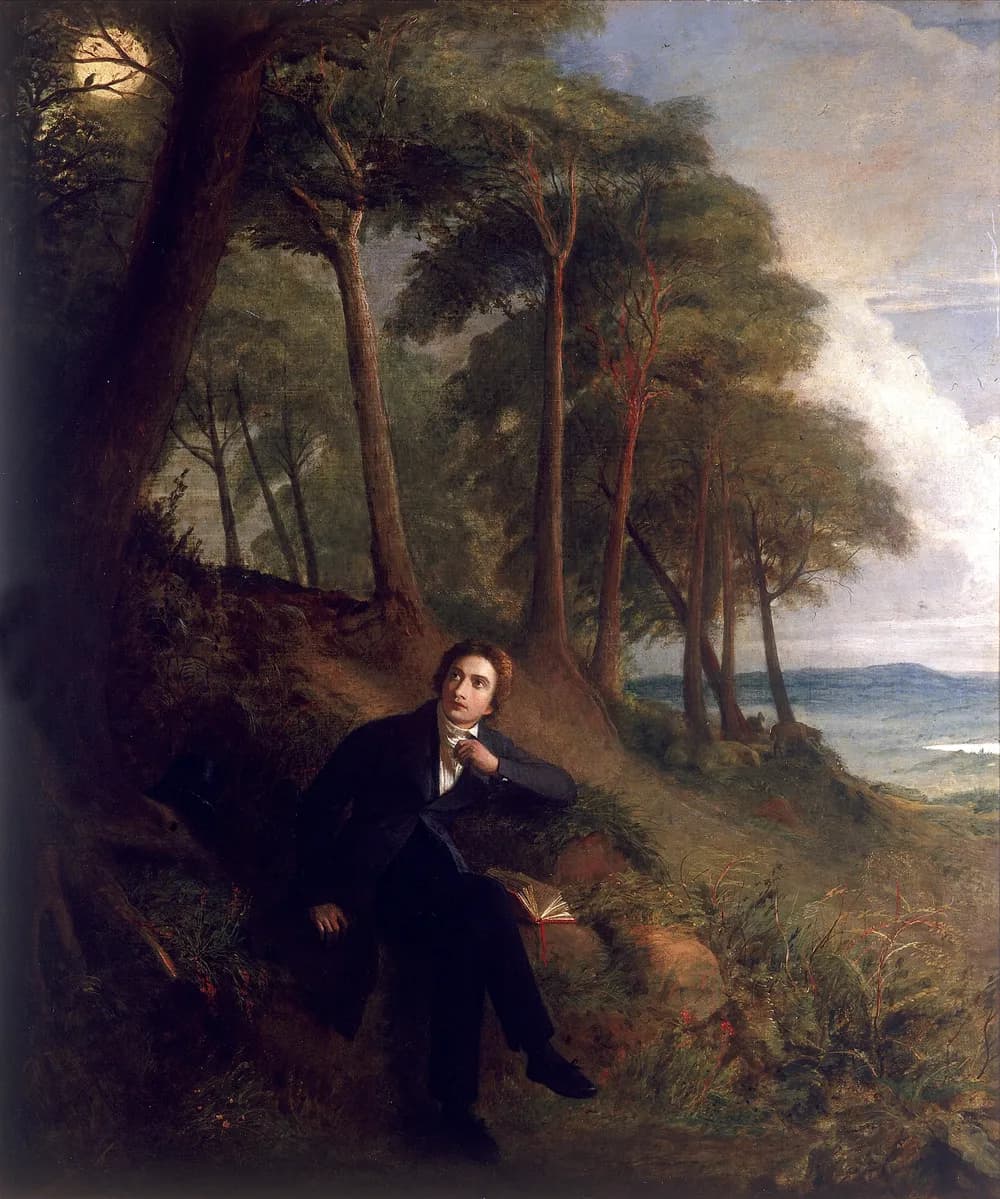
Long before John Keats became one of England's most celebrated Romantic poets, he spent his formative years at a small school in Enfield Town. The seven years he spent at Clarke's Academy between 1803 and 1810 would prove foundational to his literary development.
A Progressive Education in Market Town Enfield
Keats arrived at Clarke's School in the summer of 1803, aged seven. His parents had originally hoped to send their sons to Eton or Harrow, but the family could not afford the fees. Instead, they chose John Clarke's academy in Enfield Town, close to where Keats' grandparents lived in nearby Edmonton.
The school occupied a building on the site that would later become Enfield Town railway station. Clarke's Academy offered what contemporary accounts describe as a "liberal outlook and a progressive curriculum more modern than the larger, more prestigious schools." This progressive approach would prove far more valuable to Keats than the classical rigour of England's great public schools.
At Clarke's, Keats developed an interest in classics and history. He began a translation of Virgil's Aeneid whilst still a pupil. In midsummer 1809, aged thirteen, he won his first academic prize at the school.
The Clarke Family: Mentors in the Making
The school's headmaster, John Clarke, and particularly his son Charles Cowden Clarke, would exert a profound influence on the young Keats. Charles Cowden Clarke, born in Enfield on 15 December 1787, was only eight years older than Keats. He became teacher, friend, and lifelong mentor to the future poet.
Cowden Clarke introduced Keats to Renaissance literature, including the works of Tasso, Spenser, and Chapman's translations of Homer. These introductions were not mere classroom exercises; they opened literary worlds that would shape Keats' entire poetic career. His first extant poem, "An Imitation of Spenser," written in 1814, bears direct witness to this Enfield education. The famous sonnet "On First Looking into Chapman's Homer," composed in October 1816, traces its origins directly to these early encounters at Clarke's School.
Cowden Clarke later recalled the period after Keats left school as "the most placid time in Keats' life." Their friendship endured; in October 1816, Clarke introduced Keats to the poet and journalist Leigh Hunt, a connection that would launch Keats' public literary career.
Loss and Resilience in the Edmonton-Enfield Corridor
Keats' years in Enfield were marked by profound personal loss. His father, Thomas Keats, died in April 1804 from injuries sustained in a fall from his horse. He had been returning from visiting John and his brother George at school when the accident occurred. Keats was eight years old.
Following their father's death, Keats and his siblings went to live with their grandmother, Alice Jennings, in Edmonton village. Their mother, Frances Keats, died of tuberculosis in March 1810, when John was fourteen. These losses shadowed his time at Clarke's, yet he continued to flourish academically and intellectually.
From Schoolboy to Apprentice
In autumn 1810, aged fourteen, Keats left Clarke's School to begin an apprenticeship with Thomas Hammond, a surgeon in Edmonton. He lodged in the attic above Hammond's surgery at 7 Church Street from 1810 until 1813. The house was demolished in 1931 and replaced by Keats Parade; a blue plaque now marks the site.
The building that had housed Clarke's Academy survived until 1872, when it was demolished to make way for Enfield Town railway station. The current station building dates from the 1960s. No physical trace of Keats' school remains, yet its influence on English literature persists.
Enfield's Enduring Literary Legacy
John Keats spent approximately a decade of his short life in the Enfield-Edmonton area, from his arrival at Clarke's School in 1803 until he left his apprenticeship in 1813. In that decade, a young boy with no advantages of wealth or social position received an education that would enable him to become one of the English language's greatest poets.
The progressive curriculum at Clarke's Academy, combined with the personal mentorship of Charles Cowden Clarke, offered Keats something that Eton or Harrow could not have provided: exposure to Renaissance literature in an environment that encouraged intellectual curiosity rather than social conformity. The "Cockney School" critics who later dismissed Keats for his lack of a public school education fundamentally misunderstood how his Enfield years had prepared him for poetic immortality.
Today, Enfield Town continues as a busy suburban centre, its railway station standing on ground where a young John Keats first encountered the literature that would inspire his art. The connection between this north London borough and one of England's finest poets remains a distinctive thread in Enfield's historical fabric.